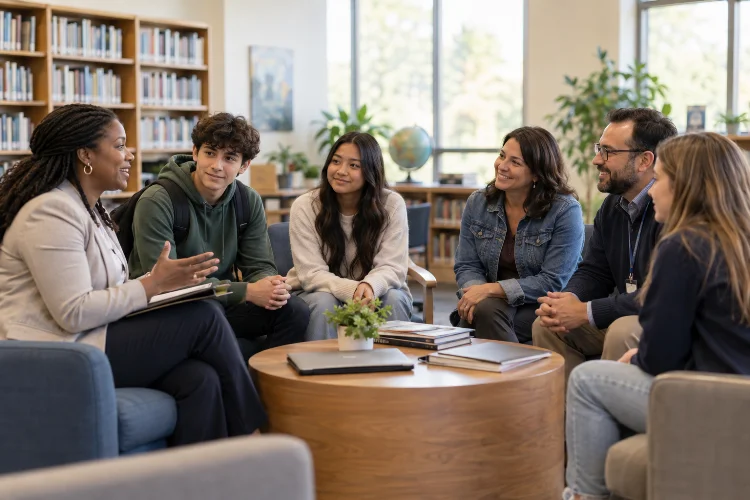
Imagine two education providers trying to reach the same group of students.
The first runs online advertisements and waits for interested students to visit its website. The second works directly with schools, speaks with counselors, organizes career sessions, meets parents, and regularly answers questions from students.
Both approaches can create awareness, but the second builds something advertising alone cannot easily produce: a trusted connection.
This helps explain why school partnerships matter for education promotion.
When universities, colleges, training providers, scholarship organizations, or educational programs develop meaningful relationships with schools, they gain a better way to understand learners and communicate relevant opportunities.
For schools, these partnerships can introduce students to courses, careers, scholarships, internships, and learning pathways they might otherwise miss. For education promoters, they create opportunities for consistent outreach instead of one-time promotional contact.
The strongest partnerships are not simply recruitment arrangements. They become relationships in which schools, learners, families, and education providers can all benefit.
School Partnerships Create Trust Before Promotion Begins
Educational decisions are personal.
Students and parents may be asked to invest years of time and significant amounts of money in a program. Naturally, they are more likely to pay attention to information that comes through a source they already trust.
Schools can provide that trusted environment.
When a counselor introduces a university representative during a career session, for example, the conversation feels different from a random advertisement appearing on social media.
This does not mean students should automatically trust everything a visiting institution says. Instead, the school provides a familiar setting where students can ask questions, compare options, and seek guidance.
Research and guidance from the U.S. Department of Education also emphasize the value of strong relationships among schools, families, educators, and communities in supporting student success.
For education promoters, trust makes meaningful communcation easier. They can move beyond simply introducing a brand and start discussing what learners actually need.
Partnerships Give Promoters Better Access to Learners
One of the biggest challenges in education marketing is reaching the right audience.
A broad digital campaign may reach thousands of people, but many of them may have little interest in the program being promoted. A school partnership offers a much more focused connection.
Suppose a technical college offers programs in engineering, information technology, and automotive services. Working with secondary schools allows its outreach team to meet students who are approaching important education and career decisions.
Promoters can organize classroom presentations, career fairs, workshops, campus visits, or small counseling sessions.
Schools can also help determine the most appropriate timing. Instead of promoting an application deadline after students have already made their decisions, providers can begin conversations earlier.
This matters because career development works best when it begins before the final moment of decision.
OECD guidance emphasizes that effective career development should help students explore future possibilities and make informed connections between education and employment.
Students Discover Opportunities They May Not Find Alone
Students cannot apply for opportunities they do not know exist.
Some learners have families and social networks that regularly discuss universities, scholarships, internships, and career possibilities. Others have much less access to this information.
This creates an information gap.
OECD research has found that students from lower socioeconomic backgrounds can face greater barriers to trusted career information and are often less likely to participate in common career-development activities.
School partnerships can help narrow that gap.
An education promoter might introduce students to scholarship programs, vocational pathways, apprenticeships, international study, online courses, foundation programs, or alternative admission routes.
For one student, the most valuable discovery might be a university scholarship. For another, it could be learning that a respected vocational qualification can lead directly into employment.
Effective education promotion therefore expands possibilities rather than pushing everyone toward the same destination.
School Staff Help Make Outreach More Relevant
Schools understand their students far better than an outside promoter does.
Teachers, counselors, and administrators often know which subjects students are interested in, what career questions are common, and what practical barriers families may face.
That knowledge can make outreach much more relevent.
Imagine an education provider planning a presentation about overseas university opportunities at a school where most students are primarily interested in affordable local vocational training. The presentation may be informative, but it does not match the audience.
A conversation with school counselors beforehand could reveal what students actually want to know.
This is where strong relatioships improve education promotion. Instead of arriving with a standard sales presentation, promoters can adapt sessions to local needs.
Schools might request information about scholarships, specific careers, application requirements, employability, financial planning, or alternative learning pathways.
The Institute of Education Sciences notes that school-community partnerships can be designed to expand access to resources, enrich learning experiences, strengthen engagement, and connect students with career pathways.
Partnerships Bring Career Exploration Into the Real World
Students often understand opportunities better when they can experience them rather than simply read about them.
School partnerships make those experiences easier to organize.
A university might invite students into laboratories. A hospitality college could offer a practical workshop. A technology training provider might run a coding session, while an employer could offer workplace visits or internships.
These activities transform an abstract career idea into something students can actually see.
OECD research on employer engagement suggests that career activities involving people from workplaces, including career talks and workplace visits, are often associated with better employment outcomes later in life.
Internships can take the connection even further. Exposure to authentic workplaces gives students opportunities to develop skills, networks, confidence, and a clearer understanding of careers.
For education promoters, experiential activities are also powerful because students experience what a field involves before deciding whether they want to pursue it.
Long-Term Relationships Work Better Than One-Off Visits
A school partnership should not disappear as soon as the recruitment season ends.
Strong outreach is built over time.
An education provider may begin with a career presentation, return later for an application workshop, invite students to an open day, provide scholarship updates, and maintain communication with counselors throughout the year.
That consistency builds credibility.
School staff gradually learn what the education provider offers, while promoters develop a better understanding of the school community.
It also becomes easier to improve future activities.
If students repeatedly ask about financial aid, the next session can include more scholarship guidance. If there is growing interest in digital careers, the institution might organize a technology workshop.
Partnerships become especially valuable when they are collaborative rather than transactional.
Research on community schools similarly emphasizes sustained partnerships among educators, families, and community organizations as a way to expand learning opportunities and provide coordinated support for students.
Strong Partnerships Can Improve Equity and Access
Education promotion is not only about increasing enrollment numbers.
It can also improve who gets access to information.
Some students actively search for educational opportunities months or years before graduation. Others may not know which questions to ask or may assume certain pathways are unavailable to them.
Schools provide a practical place to reach both groups.
OECD guidance notes that career and educational guidance can help provide more equal opportunities, particularly during transitions between levels of education and between education and employment.
Promoters can support this by ensuring outreach does not focus exclusively on students who are already confident, high-achieving, or actively seeking information.
Sessions can include students who are undecided about their futures, considering vocational routes, facing financial constraints, or needing additional support.
The objective should be to strenghten informed choice.
That distinction matters. Good education promotion should help students understand realistic options, not convince them that one institution is suitable for everyone.
Schools Also Give Education Providers Valuable Feedback
Partnerships are useful in both directions.
Education promoters bring information into schools, but schools also provide valuable information back to education providers.
Counselors might report that students find certain application instructions confusing. Teachers may notice increasing interest in a particular career field. Parents may repeatedly raise concerns about tuition, accommodation, safety, or employment prospects.
These insights can improve educational marketing and even program design.
An institution might discover that prospective learners want more flexible schedules, stronger career support, clearer scholarship information, or courses linked to emerging industries.
Instead of guessing what students want, education providers can learn directly from the people working with them every day.
This turns school outreach into more than a promotional channel. It becomes a feedback system that helps institutions communicate more clearly and respond to changing learner needs.
Understanding why school partnerships matter for education promotion comes down to one simple idea: meaningful relationships make educational opportunities easier to discover, understand, and trust.
Strong partnerships allow education providers to reach learners directly, tailor information to their needs, support career exploration, improve access for underserved students, and receive valuable feedback from schools.
Students benefit because they gain clearer information about courses, scholarships, careers, and future pathways. The best approach is long-term and collaborative rather than focused on one recruitment event.
If your organization promotes educational programs, start by identifying schools whose students could genuinely benefit from what you offer.
Build relationships with counselors and educators, listen to their needs, provide useful experiences, and focus on creating value before asking for enrollment.